Why it matters
With that many options, it is easy to think the main choice is pill or drip. That is only part of it. The more important question is which molecule raises NAD levels inside your cells most effectively.
NAD+ is one member of a family of related compounds. Some products supply NAD+ itself. Others supply a building block, called a precursor, that the body converts into NAD+. Researchers have learned a great deal about how each is absorbed, carried into cells and converted. Many questions remain open, especially whether raising NAD levels produces measurable health benefits for most people.
For a refresher on the forms, see NAD vs. NAD+ vs. NADH: What Is the Difference?
NR and NAD+: the building block and the finished molecule
NAD+ is the finished coenzyme. Cells use it in hundreds of reactions involved in energy production, DNA repair, the function of the mitochondria and cell signaling. NAD+ levels fall with age, and researchers believe that decline may contribute to changes linked with aging and some chronic diseases.
NR is not NAD+. It is a form of vitamin B3 that acts as a precursor. Once inside a cell, it is converted into NAD+ through what is called the salvage pathway. Several human studies have shown that NR taken by mouth significantly raises NAD+ in the blood.
NR has drawn interest because it is efficient. Research suggests it crosses cell membranes through dedicated transporters and enters the salvage pathway with fewer conversion steps than some other precursors.
Both molecules now come in more than one form: NR by mouth, NAD+ by mouth, NR by injection or IV, and NAD+ by injection or IV. So there are two separate questions:
- Which molecule raises NAD more effectively?
- Does the way it is given make a meaningful difference?
What is Niagen?
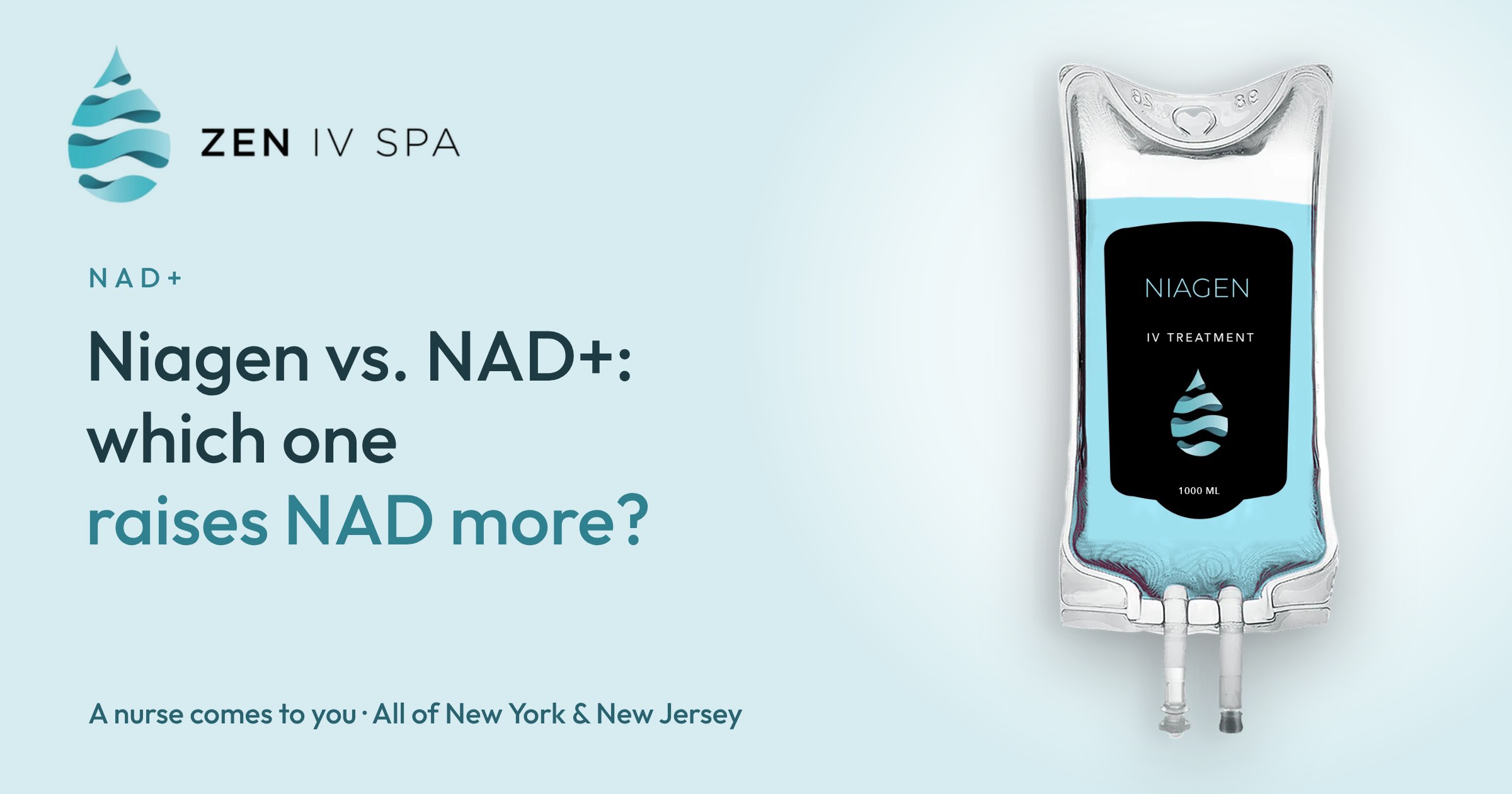
Niagen is the patented form of nicotinamide riboside chloride developed by Niagen Bioscience, formerly ChromaDex. NR is the molecule. Niagen is the branded ingredient used in many of the published human studies and in the supplement Tru Niagen.
Over the past decade Niagen has become one of the most studied NAD precursors. Human trials consistently show that it raises NAD+ and has a favorable safety profile across a range of amounts. More recently, pharmaceutical-grade injectable Niagen became available through compounding pharmacies, which allows providers to give NR by IV. That made a direct comparison with NAD+ IV possible for the first time.
NR has also had a stable regulatory history in the United States and is sold legally as a dietary supplement.
Niagen (NR) vs. NMN
NR and NMN sit in the same pathway:
NR → NMN → NAD+
NMN looks as if it has an advantage because it is one step closer to NAD+. Biology is rarely that simple. Some research suggests NMN may need to be converted back to NR before it can cross certain cell membranes efficiently. Other evidence supports a dedicated transporter that takes NMN directly into cells in some tissues. Which route matters most in people is still being worked out, and researchers have not agreed that one precursor is better.
| NR (Niagen) | NMN | |
|---|---|---|
| Human evidence | Deeper. Multiple randomized trials show higher blood NAD+ in healthy adults, older adults and people with some metabolic conditions | Growing quickly. Human studies show higher NAD levels and possible effects on metabolism, muscle function and insulin sensitivity in some groups |
| Long-term outcomes | Not yet shown to be superior | Not yet shown to be superior |
| Regulation in the US | Stable; sold as a dietary supplement | In 2022 the FDA said NMN was excluded from the supplement definition. In 2025 it reversed that position, and NMN can be lawfully marketed if notification requirements are met |
| Quality | Branded ingredient with published trials | Varies by manufacturer; choose third-party tested products |
Both reliably raise NAD markers. Researchers are still determining whether one produces better real-world results.
NR vs. NAD+: which raises NAD more effectively?
It seems logical that giving NAD+ directly would raise NAD the most. Biology may not work that way.
NAD+ is a relatively large molecule. Scientists are still studying how much of a dose reaches cells intact and how much has to be broken down outside the cell and rebuilt inside it.
NR takes a different route. It is smaller and enters the established salvage pathway, so it may be a more efficient way to refill NAD+ inside cells.
The first head-to-head IV comparison
In 2024, investigators working with ChromaDex released a randomized pilot study comparing pharmaceutical-grade Niagen IV, traditional NAD+ IV, oral NR and placebo in healthy adults. Compared with NAD+ IV, people who received Niagen IV had:
- Shorter infusion times
- Better tolerability, with fewer infusion-related side effects
- Larger short-term rises in blood NAD+ within 24 hours
NAD+ IV took substantially longer and caused more discomfort during the infusion.
Those findings challenge the long-held assumption that giving NAD+ directly is the most effective approach. The limits matter too. The study was funded by ChromaDex, the maker of Niagen. Several authors were company employees. It was released as a preprint and has not appeared in a peer-reviewed journal. That does not invalidate the results. It means they should be read with caution until independent researchers repeat them in larger trials.
For now, the strongest conclusion is that both approaches raise NAD-related markers, and meaningful differences in health outcomes remain uncertain.
Pills or IV: does the route matter?
Yes, though perhaps not in the way people expect.
Anything taken by mouth passes through the digestive system, where part of it is broken down before reaching the bloodstream. That applies to NR, NMN and oral NAD+ alike. An IV delivers the compound straight into the blood, and an injection bypasses most of digestion. Both reach higher blood levels faster than a pill.
That does not automatically mean better long-term results. Oral NR has repeatedly raised blood NAD+ in human trials despite passing through the gut. Whether the rapid rise from an IV leads to better outcomes than daily pills is still being studied.
Convenience counts as well. A daily pill is easy to keep up and costs less. An IV or injection needs an appointment, a qualified professional and a higher spend. For people who cannot tolerate pills, have digestive conditions that affect absorption, or want rapid replenishment under medical supervision, that trade can be worthwhile.
Which is right for you?
For long-term daily support. An oral precursor is often the practical place to start. NR has the strongest human evidence for raising blood NAD+ and an established regulatory history. NMN is promising, with a somewhat smaller body of evidence and more variation in product quality.
For rapid replenishment. A drip or injection delivers the compound directly, without relying on absorption through the gut. It suits people who want medically supervised treatment or have trouble with oral supplements. Whether NR IV proves superior to NAD+ IV is an active area of research. The early company-sponsored pilot points that way and needs confirmation.
For healthy aging. This is where to be most careful. Falling NAD levels are associated with aging, and an association does not prove cause. There is no high-quality clinical evidence that NR, NMN or NAD+ therapy reverses aging or extends human life. These therapies may help replenish declining NAD levels. How far that translates into better health, function or longevity is still under investigation.
When to talk to a provider
A qualified provider can help you weigh:
- Your overall health and medical history
- Current medications and possible interactions
- Whether a pill or an injectable therapy fits your goals
- The right amount and how to monitor it
- Whether another condition is behind symptoms such as fatigue
If you choose an oral supplement, pick a reputable manufacturer that uses third-party testing. Newer or more expensive does not mean better.
NAD therapy with Zen IV Spa
We offer NAD+ drips in 250, 500 or 1,000 mg, a Niagen IV, and NAD+ injections that can be shipped to you after a provider visit. A licensed provider reviews your health history by video first, explains the strengths and limits of each option, and helps you choose. A licensed nurse brings the drip to your home, office or hotel anywhere in New York & New Jersey and stays the whole time. Our medical director oversees every treatment.
Quick answers
Is Niagen (NR) the same as NAD+? No. Niagen is a branded form of nicotinamide riboside, a precursor your body converts into NAD+. NAD+ is the finished coenzyme cells use for energy and many other processes.
Niagen (NR) vs. NMN: which is better? There is no definitive winner. Both raise NAD levels. NR has more published human research and a longer regulatory history in the United States. NMN has encouraging human data, and more comparative studies are needed.
Does Niagen come as an IV or injection? Yes. Pharmaceutical-grade NR is available through certain providers as an injection or IV, prepared by qualified compounding pharmacies. Availability varies by provider and state.
Is Niagen IV better than NAD+ IV? It is too early to say. A company-sponsored pilot study reported larger short-term rises in blood NAD+, shorter infusions and better tolerability with Niagen IV. It has not yet been independently repeated or peer reviewed.
Which NAD booster is best for energy or healthy aging? No NAD therapy has been proven to reverse aging or to improve energy in everyone. NR, NMN and some injectable therapies raise NAD levels. The best choice depends on your goals, medical history and budget, and a conversation with a qualified provider.
How long does each IV take? NAD+ runs slowly, over one to four hours. In the pilot study, Niagen IV took substantially less time.
Not sure which one fits? Use "Ask a Provider" at zenivspa.com before you book.
Sources: McReynolds, Chellappa & Baur, Experimental Gerontology 2020 (age-related NAD+ decline); Trammell et al., Nature Communications 2016 (nicotinamide riboside is uniquely and orally bioavailable in mice and humans); Conze, Brenner & Kruger, Scientific Reports 2019 (safety and metabolism of long-term Niagen in healthy overweight adults); Shade, Integrative Medicine 2020 (the science behind NMN); Martens et al., Nature Communications 2018 (NR in healthy middle-aged and older adults); Yi et al., GeroScience 2023 (NMN in healthy middle-aged adults); ChromaDex-sponsored randomized pilot of Niagen IV, NAD+ IV and oral NR, medRxiv preprint 2024; US Food and Drug Administration, new dietary ingredient notifications and 2025 position on NMN; Christen et al., Nature Metabolism 2026 (three NAD+ boosters and circulating NAD in humans). Educational content, not medical advice.
Ready to book?
Call or text (332) 239-2005, or book online. A licensed nurse comes to you anywhere in all of New York & New Jersey, 8 AM to 11 PM, seven days a week.
All treatments are medical services. Every guest is screened, and every treatment is provided only under the clearance, prescription or standing protocol of a licensed medical provider. Compounded peptides are not FDA-approved unless stated. Nothing on this page is a diagnosis or a promise of results.