Why it matters
The practical questions are what it can do for aging skin and what results you should expect. The answers come from how this copper peptide works with the skin's own repair systems.
What can GHK-Cu cream do for skin?
GHK-Cu is short for glycyl-L-histidyl-L-lysine copper. It is a copper-binding peptide that occurs naturally in human plasma, saliva and urine. Researchers identified it decades ago and later found that levels decline with age.
Its potential goes beyond appearance. Research suggests GHK-Cu can influence the activity of genes involved in tissue repair, control of inflammation, antioxidant defense and remodeling of the extracellular matrix, the network of proteins that keeps skin strong, resilient and youthful.
Applied to the skin, GHK-Cu is believed to support:
- Skin regeneration
- Collagen production
- Maintenance of elastin
- Wound healing
- Control of inflammation
- Antioxidant defense
It does more than mask the signs of aging. It appears to support the systems under the surface that determine skin health.
What is GHK-Cu cream?
GHK-Cu cream is a skincare product made with this copper peptide. In simple terms, GHK-Cu is a small protein fragment that binds to copper. Copper is an essential trace mineral involved in collagen production and wound healing. The peptide acts as a delivery system, helping carry copper to where it may be useful in the skin.
Copper peptides belong to a group of ingredients that support the skin's structure. They do not aggressively exfoliate or resurface it. Skin repair and collagen production are key to keeping skin healthy over time.
How does GHK-Cu work?
GHK-Cu is often described as a signaling molecule. It helps "communicate" with the skin and encourages the processes tied to repair and maintenance. Skin is always responding to signals from inside and outside the body. Those signals influence how it makes proteins such as collagen, how it repairs minor damage, and how it keeps its barrier.
- Skin tissue. Research suggests copper peptides can influence tissue remodeling and regeneration, including the activity of the cells that make structural proteins.
- Collagen production. Copper is part of the enzyme reactions that produce collagen and elastin, both essential for skin structure and resilience.
- Antioxidant activity. Skin is exposed every day to UV light and pollution. Copper peptides have been studied for their ability to help neutralize some of the free radicals these create, which may add to the skin's own defenses over time.
GHK-Cu is not an exfoliant or a resurfacing agent. It supports the skin's natural processes, which is why results appear gradually.
Anti-aging benefits
May support collagen production. Collagen is one of the skin's main structural proteins. As it declines with age, skin becomes thinner, less firm and more prone to wrinkles. Research suggests GHK-Cu may stimulate fibroblasts, the cells that make collagen and other connective tissue. Supporting collagen may improve firmness and resilience over time.
May help maintain elastin and elasticity. Collagen gives structure. Elastin lets skin stretch and spring back. Loss of elastin leads to sagging. Some research indicates that copper peptides help support elastin and healthy connective tissue. No cream can fully reverse age-related loss of elasticity, but supporting these proteins may improve overall skin quality.
May improve fine lines and texture. Several studies of products containing copper peptides have reported smoother skin, better texture and softer fine lines. These gains likely come from several effects working together: more collagen, better repair and less inflammatory stress. For early signs of aging, texture is often the most noticeable change.
Supports skin repair and recovery. One of the most studied properties of GHK-Cu is its role in wound healing and tissue regeneration. Cosmetic use is different from wound care, but the same repair activity explains its use in skin rejuvenation. Better repair means smoother, stronger, more resilient skin over time.
May help reduce inflammatory stress. Chronic low-grade inflammation is increasingly recognized as a driver of skin aging. Sun, pollution and oxidative stress trigger it. GHK-Cu has shown anti-inflammatory properties in multiple research settings, which may help skin function and recover from everyday stress.
How it supports healthier-looking skin over time
The benefits of GHK-Cu are gradual. It does not give the instant plumping some products do. It is a long-term ingredient. With consistent use it may contribute to:
- Smoother texture
- More even tone
- Better retention of moisture
- Softer fine lines
- Greater resilience
- Healthier skin overall
These visible changes are thought to come from support of the tissue underneath, not from a temporary cosmetic effect.
What results can you realistically expect?
Likely improvements, usually after several weeks to several months of consistent use:
- Softer skin
- Smoother texture
- Softer fine lines
- Better overall appearance
- Better recovery after environmental stress
What it is unlikely to do:
- Remove deep wrinkles
- Tighten skin the way a facelift does
- Reverse advanced sagging
- Produce a dramatic overnight change
GHK-Cu is not a substitute for medical or procedural treatment when aging is advanced. Its value is in cumulative improvement.
Why it takes time. A skin renewal cycle takes about 28 days, and it slows with age. GHK-Cu supports the underlying processes and does not force rapid turnover, so results follow that natural timeline. In the first few weeks some people notice better hydration or smoother texture. Changes in firmness and fine lines show later. Consistency is the most important factor. Skipping applications or switching products often can limit results.
How to use GHK-Cu cream
Using it well comes down to consistency, simplicity and sensible pairing.
- How often. Most people apply it once or twice a day, depending on the product and how their skin tolerates it. Beginners do well starting once a day and increasing if the skin is comfortable.
- Where it goes in a routine. After cleansing. After light, water-based serums such as hyaluronic acid. Before heavier moisturizers, facial oils and sunscreen. Thin products go on before thick ones so each can absorb.
- Pairing with other actives. It is compatible with most common products. Many people avoid applying it at the same time as strong exfoliating acids, such as glycolic or salicylic acid, or potent retinoids, especially at the start. A common approach is GHK-Cu in the morning and retinoids in the evening.
- Moisturizer and sunscreen. Both are important partners. Daily sunscreen is widely recommended, and sun protection is a key step in preventing premature skin aging.
Best use cases
| Who | Why it fits |
|---|---|
| People noticing early signs of aging | Supporting collagen and repair early may help maintain healthier skin |
| People focused on long-term skin health | It suits a prevention and maintenance approach more than a quick fix |
| Skin recovering from environmental stress | Its antioxidant and repair support may help recovery from sun and pollution |
| Mature skin | As natural repair slows with age, ingredients that support repair and the skin's structure may be especially useful |
| People in their 30s and beyond focused on healthy aging | Copper peptides fit a long-term maintenance plan |
| Sensitive skin | Copper peptides are generally considered gentler than strong exfoliating acids or prescription retinoids, though responses vary |
| People who layer several supportive ingredients | It fits well in a routine that does not rely on one "hero" active |
Side effects and limitations
GHK-Cu is generally well tolerated on the skin, and most people have few problems.
- Mild irritation. Some people get temporary redness, irritation, sensitivity or dryness. A patch test is recommended before regular use.
- Go slowly with very sensitive skin or an existing skin condition. Introduce it gradually and watch how your skin responds. If irritation continues, stop and speak with a healthcare professional.
- Keep the routine balanced. Too many active ingredients at once raises the risk of irritation, even when each one is gentle.
- Product quality matters. Peptide concentration, stability of the formula, the delivery system and manufacturing quality all affect how well a product works.
- Research is still developing. The science is promising. Researchers are still working out the best amounts, long-term outcomes and the full extent of the anti-aging effect. No skincare ingredient is a guaranteed solution.
The takeaway
GHK-Cu cream stands out because its anti-aging potential is tied to skin health itself. Research suggests it may support collagen production, tissue repair, control of inflammation and overall skin quality, all of which shape how skin ages. For gradual, science-supported improvement in texture, resilience and visible signs of aging, it can be a valuable part of a complete skincare plan.
Peptide-based skin support with Zen IV Spa
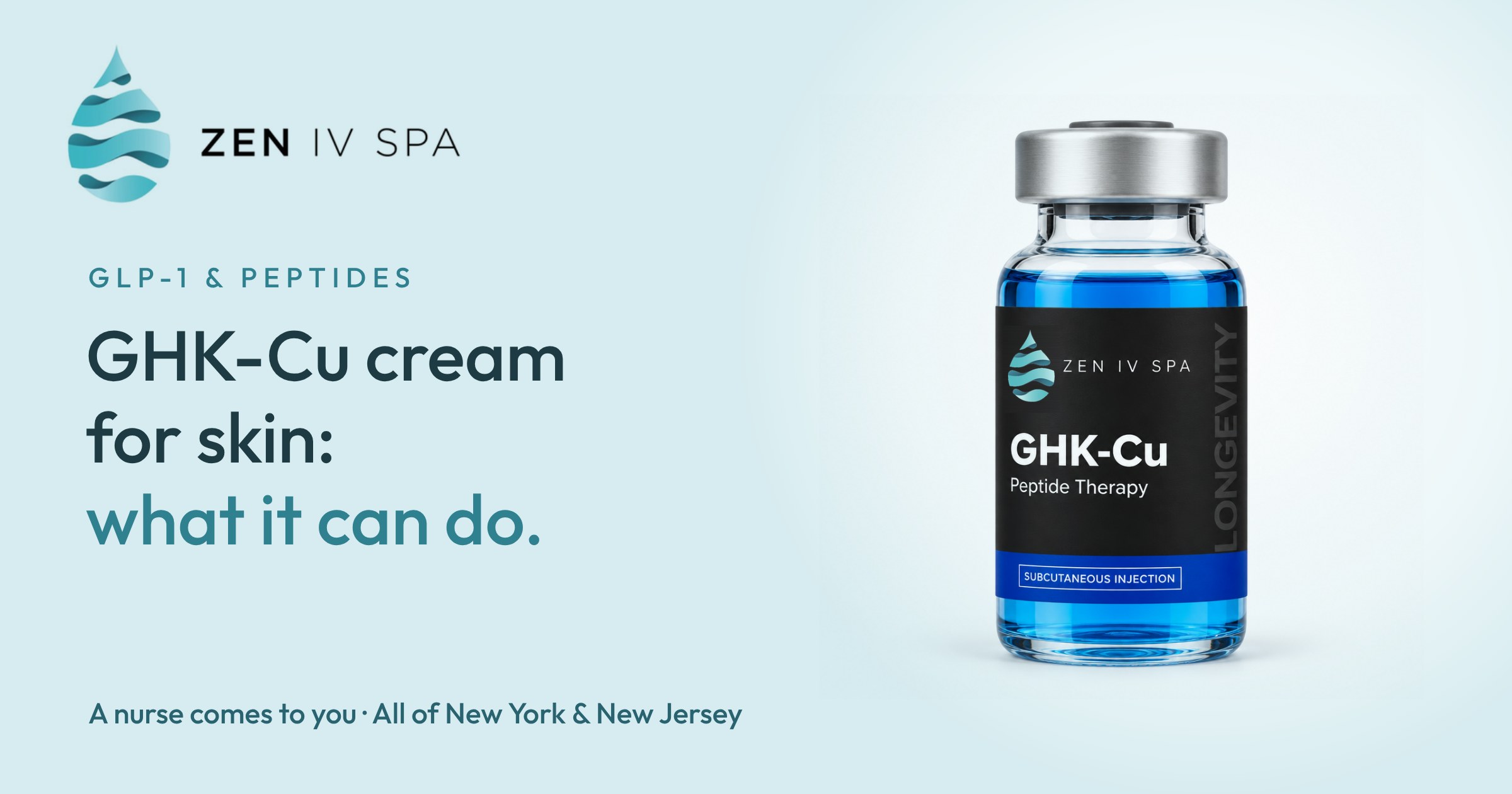
GHK-Cu is one of the peptides in our programs. A licensed provider reviews your health history and goals first, and can tell you whether copper peptides fit and how they work alongside other evidence-based approaches such as sunscreen and retinoids. Peptides are prepared by a licensed compounding pharmacy on a prescription and shipped to you. We serve all of New York & New Jersey, and our medical director oversees every treatment.
See Peptides. Related reading: Peptides for Skin and Anti-Aging: Which Ones Have Evidence?
Quick answers
Is GHK-Cu cream good for aging skin? It is often used for aging skin because research suggests it may support collagen production, tissue repair and healthy skin function. These effects may improve skin quality and reduce some visible signs of aging over time.
How long does it take to show results? Many people notice better texture and appearance within several weeks. Changes in firmness and skin quality usually take several months of consistent use.
Can it help with wrinkles and texture? It may improve texture and soften fine lines by supporting collagen production and skin repair. Results are gradual.
Who is a good candidate? Adults with early or moderate signs of skin aging, people focused on long-term skin health, and those who want science-based ingredients.
What is GHK-Cu cream used for? It is used to support skin texture, firmness and the appearance of fine lines, usually in a routine built around long-term skin health.
Is GHK-Cu cream the same as copper peptides? GHK-Cu is one specific copper peptide. All GHK-Cu products are copper peptides, but not all copper peptides are GHK-Cu.
How often should it be used? Most people start once a day and move to twice a day if the skin tolerates it, depending on the product.
Is it gentle enough for sensitive skin? Many people with sensitive skin tolerate it well. Reactions vary, so patch test and introduce it gradually.
Curious whether copper peptides fit your skin? Use "Ask a Provider" at zenivspa.com/peptides/.
Sources: Pickart & Margolina, International Journal of Molecular Sciences 2018 (regenerative and protective actions of the GHK-Cu peptide in the light of the new gene data); Dou, Lee, Zhu, Morton & Ladiges, Aging Pathobiology and Therapeutics 2020 (the potential of GHK as an anti-aging peptide); Rodan, Fields, Majewski & Falla, Skincare Bootcamp: The Evolving Role of Skincare (National Library of Medicine, PMC5172479); Healthline, How Copper Peptides Assist the Health of Your Skin and Hair. Educational content, not medical advice.
Ready to book?
Call or text (332) 239-2005, or book online. A licensed nurse comes to you anywhere in all of New York & New Jersey, 8 AM to 11 PM, seven days a week.
All treatments are medical services. Every guest is screened, and every treatment is provided only under the clearance, prescription or standing protocol of a licensed medical provider. Compounded peptides are not FDA-approved unless stated. Nothing on this page is a diagnosis or a promise of results.